


Maldives’ Floating Solar Islands: Powering Paradise Sustainably
- MOG Team

- Sep 14, 2025
- 3 min read

The Maldives, renowned for its glittering lagoons and eco-sensitive marine environments, is increasingly embracing renewable energy to reduce its reliance on diesel generators. A recent innovation, the SolarSea System by the company Swimsol, introduces floating solar islands — platforms equipped with photovoltaic panels, moored off the coast, designed to produce clean energy for resorts and local communities. This Marine & Nature feature explores how these floating solar islands work, their benefits and challenges, and what this means for Maldives’ marine environment and sustainability goals.
What Are Floating Solar Islands?
Floating solar islands are systems of solar panels installed on buoyant platforms that float on water bodies—lagoons, bays, or calm coastal zones. In the Maldives, the SolarSea system uses modular floating platforms that are relatively simple to assemble and easy to expand. They can be placed off resort islands, over reef flats or lagoons, wherever conditions allow stable anchoring and minimal disturbance to marine habitats.
These installations are intended as clean energy solutions for resorts and small islands that currently depend heavily on imported fuel, helping reduce carbon emissions and ecological footprint.
How It Works in the Maldives
Installation & Infrastructure: The systems float, anchored to minimize movement, and have weatherproof cabling running to island-based utility systems.
Scalability: One of the key features is modularity: resorts can start small and scale up as demand grows.
Energy Use: The generated solar power can cover lighting, air conditioning, water pumping, cooking, and other resort operations.
Advantages for Marine & Nature
Lower Carbon Emissions: Reducing use of diesel generators which emit greenhouse gases and risk fuel spillage.
Less Land Use: The Maldives has limited flat land; floating solar frees terrestrial area for other uses, including preserving natural habitats.
Potential for Reef Protection: By powering resorts cleanly, the stress on ecosystems from fossil fuel combustion and runoff can be reduced.
Tourism Appeal: Sustainable practices like floating solar often appeal to eco-conscious travelers looking for green resorts.


Challenges & Environmental Considerations
Marine Habitat Impact: Floating platforms can cast shadows, potentially affecting photosynthesis in coral and seagrass beds. Anchoring must be done carefully to avoid damaging reefs.
Maintenance & Durability: Exposure to saltwater, waves, storms, and biofouling (algae, barnacles) can degrade panels or mounting. Corrosion and wear are non-trivial issues.
Cost & Return on Investment: Initial setup cost is high. Maintenance over years needs to be budgeted. For smaller islands, financing or grants may be required.
Weather Variability: Cloud cover, monsoon rains, and waves reduce daily solar output. Must be paired with backup power solutions or battery storage.
Real-World Examples & Maldives Context
Swimsol’s SolarSea is one of the visible projects in the Maldives exploring floating solar islands, aiming to reduce reliance on diesel for luxury resorts and inhabited islands.
Maldives government and private operators have already been adopting hybrid renewable energy systems (solar + battery + diesel) in outer islands. Floating solar is a logical extension of this trend.
Resorts with large lagoons and calm coastal waters are better suited. Resorts near reef flats, shallow lagoons, or wide lagoon expanses can host floating solar more easily than those in rough open ocean.
Resorts Leading in Renewable Energy
While floating solar islands are still emerging, some Maldivian resorts already stand out for their renewable energy adoption and sustainability leadership.
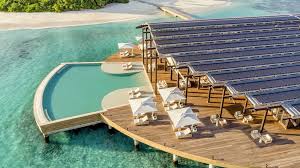
Kudadoo is one of the Maldives’ most ambitious eco-luxury projects. The resort is 100% powered by solar energy, making it one of the world’s first fully solar-powered luxury private islands. Solar panels cover much of the architecture seamlessly, powering villas, dining, and guest facilities. Its luxury all-inclusive concept proves that top-tier experiences can co-exist with sustainability.
Both Soneva properties run extensive solar installations and have strong sustainability programmes, including waste-to-wealth recycling, glass studios, and sustainable food sourcing. They aim for net-zero waste and significant renewable contributions to daily operations.
Known for marine conservation partnerships, Six Senses Laamu integrates renewable energy solutions with eco-design. It actively contributes to reef protection and marine science, aligning guest experience with environmental stewardship.
Part of The Leading Hotels of the World, Finolhu has invested in solar and energy-saving technologies to reduce diesel dependence. It also emphasizes reef protection, waste management, and eco-friendly guest programmes.
Though smaller in scale, Fushifaru has adopted solar solutions for day-to-day operations and implements eco-driven initiatives around water conservation and waste management.
What This Means for Travelers
When planning a stay in the Maldives, guests seeking eco-friendly and halal-conscious travel can now choose properties that integrate renewable footprints. From Kudadoo’s fully solar-powered island to Soneva’s holistic sustainability model, these resorts show that luxury and responsibility can go hand in hand.


Comments